Investing Glossary
Clear, plain-English definitions for terms related to the stock market and investing.
Jump to letter:
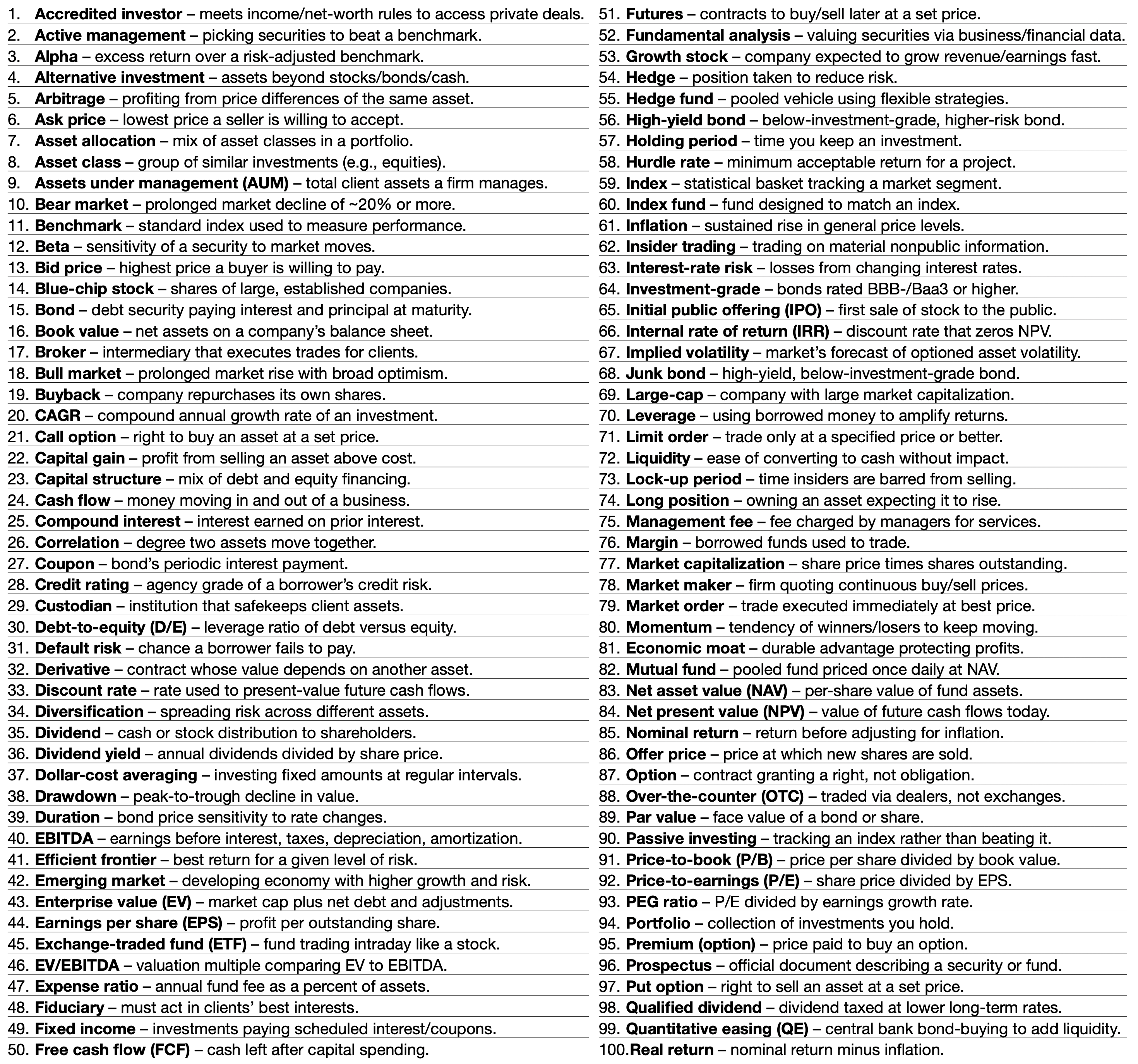
Asset Class
A broad category of financial instruments that behave similarly in the marketplace. The main asset classes are equities (stocks), fixed income (bonds), cash, and property/real estate.
Bonds (Fixed Income)
A loan made by an investor to a borrower (typically a corporation or government). The borrower promises to pay back the original sum on a specific date, plus regular interest payments (the coupon) along the way.
Capital Gains
The profit earned when you sell an investment for more than you paid for it. In the UK, profits above a certain annual allowance are subject to Capital Gains Tax, unless the investments are held within a Stocks and Shares ISA.
Dividend
A portion of a company's profit distributed to its shareholders. Dividends provide investors with a regular income stream in addition to any potential increase in the share price.
Equities (Stocks and Shares)
Units of ownership in a company. When you buy equities, you become a partial owner (shareholder) of that business, sharing in its profits and its risks.
Exchange-Traded Fund (ETF)
A type of investment fund that is traded on stock exchanges, much like individual stocks. They usually track a specific index, sector, or commodity, offering a cheap way to instantly diversify your portfolio.
Index Fund
A mutual fund or ETF designed to follow certain preset rules so that the fund can track a specified basket of underlying investments (an index), such as the FTSE 100 or S&P 500. They offer broad market exposure and low operating expenses.
P/E Ratio (Price-to-Earnings)
A valuation ratio calculated by dividing a company's current share price by its earnings per share. It helps investors determine whether a stock is overvalued or undervalued compared to its peers.
Stocks and Shares ISA
A UK tax-efficient investment account. Any capital gains or dividends earned from investments held within this ISA are completely free from UK tax, up to the annual allowance limit (currently £20,000).
Yield
The income returned on an investment, expressed as a percentage of the investment's cost or current market value. For stocks, this is the dividend yield; for bonds, it is the interest rate relative to the bond's price.
Update: Check Your Eligibility Today
Click the button below to view your updated credit score and identify any potential errors instantly.
CHECK YOUR CREDIT SCORE NOW*Secure, 256-bit encrypted connection.